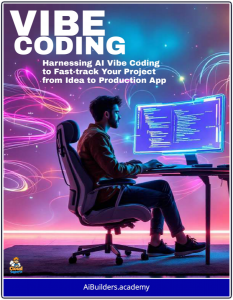
Vibe Coding – Harnessing the Semantic Shift in Digital Production
For the startup founder in 2025, this shift signifies that the primary constraint on venture creation is no longer technical literacy or engineering headcount, but rather the clarity of product vision and the ability to orchestrate AI agents.

 The trajectory of software development has historically been defined by increasing layers of abstraction—from binary to assembly, to high-level languages, and now, to natural language itself.
This latest evolution, colloquially termed “Vibe Coding,” represents a fundamental decoupling of architectural intent from syntactic implementation.
For the startup founder in 2025, this shift signifies that the primary constraint on venture creation is no longer technical literacy or engineering headcount, but rather the clarity of product vision and the ability to orchestrate AI agents.
This research report provides an exhaustive analysis of the Low Code AI and Vibe Coding landscape, specifically tailored for entrepreneurs seeking to transition from concept to deployed application without traditional engineering teams.
By examining market leaders such as Lovable, Replit, Bolt.new, Bubble, and the Google ecosystem, this document delineates the critical path for digital business creation.
The analysis reveals that while AI acceleration dramatically reduces time-to-market—research indicates citizen development models can accelerate lifecycles by up to 5.8x—it necessitates a new operational competency: the ability to manage stochastic AI outputs through rigorous prompt engineering, security oversight, and architectural governance.
The Vibe Coding Paradigm: Theoretical Framework and Market Context
The term “Vibe Coding” was crystallized by AI researcher Andrej Karpathy in early 2025 to describe a workflow where the human developer shifts from a writer of syntax to a manager of generative outputs.
Unlike traditional coding, or even AI-assisted pair programming (e.g., GitHub Copilot), Vibe Coding is characterized by the user’s willingness to “forget that the code even exists,” entrusting the implementation details entirely to Large Language Models (LLMs) while focusing on the “vibe,” or the functional and aesthetic outcome of the application.
This paradigm rests on the premise that natural language has become the highest-level programming language. As noted by industry observers, this shift allows non-technical creators—entrepreneurs, designers, and domain experts—to construct complex digital products by describing them in English.
However, this is not merely a passive process. It requires an iterative loop of “Ideation, Generation, Observation, and Refinement,” where the human director acts as the quality assurance gatekeeper, steering the AI away from hallucinations and towards business logic compliance.
The Economic Imperative and the “Bill Gates Moment”
The economic implications of this shift are staggering. Gartner reports that AI-assisted code development is on track to account for 40% of all new business software. Industry leaders have likened this transition to a “Bill Gates or Mark Zuckerberg moment,” suggesting that the next generation of tech giants will be built by individuals who master these tools early.
The reduction in barrier to entry fundamentally alters the startup cost structure. Where a Minimum Viable Product (MVP) previously required tens of thousands of dollars and months of engineering time, Vibe Coding platforms allow for the deployment of revenue-generating applications in days or weeks, often by solo founders.
This democratization of software capital means that “sweat equity” is increasingly defined by prompt engineering skill rather than coding proficiency.