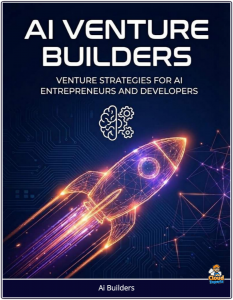
AI Venture Builders – Venture Strategies for AI Entrepreneurs and Developers
Introducing our book for aspiring entrepreneurs who want to leverage the most powerful technology in history to launch a new startup venture.

 The world of entrepreneurship has entered its most transformative era yet.
Artificial intelligence is no longer merely a tool or a passing buzzword; it has become the foundational infrastructure for creating entirely new categories of businesses, often at speeds and scales that seemed unimaginable just a few years ago.
Welcome to AI Venture Builders: Venture Strategies for AI Entrepreneurs and Developers.
This book is written for the builders operating at the frontier: solo developers who ship minimum viable products in weeks, technical founders who balance model selection and fine-tuning while pitching seed rounds, product engineers who transform domain-specific problems into defensible AI-native companies, and repeat entrepreneurs now running—or joining—AI-focused venture studios and builders that systematically launch multiple AI-powered ventures.
We are living through a dramatic compression of startup timelines. What once required 18 to 36 months—idea validation, prototyping, early traction, and fundraising—can now unfold in months or even weeks when approached correctly. Small, ambitious teams equipped with frontier models, open-source tooling, synthetic data pipelines, prompt chaining, agentic workflows, and low-cost compute are routinely out-executing much larger organizations.
Yet for every headline-grabbing success like Cursor, Perplexity, Harvey, or Cohere, thousands of AI initiatives quietly fail. Too often, founders treat AI as magic pixie dust rather than a powerful but unforgiving multiplier of fundamental venture discipline.
The central thesis of this book is simple yet hard-won: AI changes the physics of company-building, but it does not suspend the laws of markets, customers, capital, distribution, defensibility, or unit economics.
The most successful AI entrepreneurs and venture builders today are not those chasing the shiniest new model release. Instead, they are the ones who ruthlessly combine a deep understanding of painful, recurring, and monetizable problems in specific verticals or workflows with mastery of where current AI capabilities create asymmetric advantage—and where they remain brittle.
They pursue capital-efficient paths to early revenue and defensibility through data moats, workflow lock-in, proprietary evaluation loops, and specialized fine-tunes. They navigate modern fundraising realities in an era where AI-native companies can demonstrate meaningful traction with tiny teams and modest burn rates. Above all, they follow repeatable playbooks for ideation, validation, building, go-to-market, and scaling—often within venture studio or builder environments.
This book distills strategies and mental models from the current generation of AI builders—those creating vertical AI compounds, agent platforms, developer tools, enterprise copilots, synthetic data factories, and entirely new automation layers. It bridges classic startup wisdom, including customer development, lean iteration, and capital strategy, with the new realities of 2026 AI entrepreneurship.
Readers will learn how to choose problems where AI delivers 5–50× performance leaps rather than marginal 20% gains, how to architect data advantages before competitors do, and how to navigate the relentless model treadmill without being made obsolete by the next release from OpenAI, Anthropic, xAI, DeepSeek, or others.
The book covers building capital-efficient “venture studio speed” even as a solo founder or micro-team, raising capital in a world where investors increasingly demand early revenue, quantifiable ROI, and paths to $10M–$100M ARR with teams of just 5–20 people, and deciding whether to go standalone, join or launch a venture builder, or build inside a corporate innovation lab.
Whether you are a developer turning late-night side projects into your full-time company, a domain expert finally able to productize years of proprietary knowledge with AI, a repeat founder now running or considering an AI venture studio, or simply someone who wants to build something that matters in the AI era, this book serves as your tactical field guide.
The next decade will be defined by who can turn intelligence into durable, compounding businesses—not just who has access to the smartest models.
Let’s build.